Beautiful Built-In Lighting Starts Before the Cabinets Are Finished
By Lawrence Walters, Imagined Home Technology
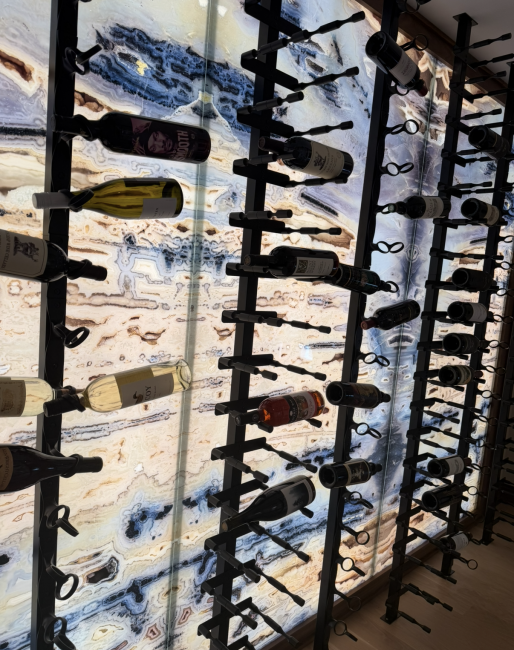
We worked on a wine room with a wall of printed glass that became one of the major design features in the home.
When it was finished, it felt warm, intentional, and really impressive. The client was stoked.
Getting there involved a choice that I think says a lot about how we approach lighting.
We used an LED sheet product with selectable color temperature at the drivers. That gave us the ability to adjust the look of the light without the added expense and control requirements of the tunable sheet option we had considered.
For this project, the selectable sheet option was roughly half the cost of that alternative.
The drivers were accessible in the mechanical room. Changing the color-temperature setting meant adjusting a switch on each driver—a quick process for our team if the look needed to be changed.
The client had flexibility, the design had the effect it needed, and we kept the solution straightforward.
That is the kind of decision I enjoy helping people make. Understand what will create a great result, then build the right plan around it.
An Inspiration Photo Starts the Conversation
When a designer sends me an image of illuminated shelves, cabinetry, or an architectural feature, it helps me understand the general vision.
What is catching their eye? Is it the warmth? The way the light reveals a material? The fact that the source seems to disappear?
The photo is a useful starting point. It doesn't tell us everything about how to reproduce that effect in a particular home.
We still need to understand the dimensions, the materials, the available space, and how the feature is being built.
Lighting is a fast-moving category, and the range of products available to our industry keeps expanding. If the request is unusual, I like to involve our vendor support early.
They know their products and can help us identify what will create the effect. Just as usefully, they can help eliminate options that won't work with the physical conditions.
That collaboration lets us move toward a practical plan with more confidence.
Start With What Makes the Material Beautiful
The lighting approach should follow what we're trying to highlight.
Sometimes the goal is to illuminate a surface from behind. Sometimes a silhouette is more interesting. In other situations, directing light across the face of a material helps reveal its texture.
With wood, we may want to bring out the grain. With stone, it may be the color, texture, or translucency that makes the feature special.
The direction of the light matters. So do its brightness and color temperature.
Backlighting stone can be particularly tricky. The wrong product or layout can leave dark areas or produce a color that doesn't complement the material. We also need to understand how the client wants to control it.
Those are questions to work through while we can still influence the construction.
A beautiful material deserves a lighting plan that helps it look its best.
Millwork Is Part of the Lighting Plan
A lot of the difference between lighting that feels intentional and lighting that feels added afterward comes down to millwork and planning.
When the cabinetmaker or carpenter is involved early, we can coordinate how the light will fit into the construction. Where will the product sit? How will it be concealed? Where will the wiring go? What will someone see from the normal viewing positions?
There are discreet products that can create a really impressive result, but they need space and the right installation details.
For custom cabinet lighting in Birmingham, Northville, and other Southeast Michigan homes, I want that conversation happening before fabrication decisions are locked in.
The designer establishes the visual direction. We help identify a lighting approach that supports it. The cabinetmaker, builder, and electrician help turn that shared plan into something that can actually be installed.
Everyone has information the other trades need.
The Equipment Needs a Home, Too
Drivers are one of the most overlooked parts of built-in lighting.
These are the components that provide the appropriate power to the lighting. Depending on the system, they may also be involved in dimming or color adjustment.
On a larger project, there can be a substantial number of them. They can take up more cabinet or wall space than people expect.
If nobody has planned where they belong, the installation can become a mess surprisingly quickly.
We need to carve out suitable space with the architect or designer early, then coordinate the electrical and low-voltage requirements with the team.
Access matters just as much as concealment.
I don't want a future service visit to require crawling into an awkward space or taking finished work apart just to reach a component. The location needs to suit the equipment's installation requirements and allow practical access.
In the wine room project, having the drivers accessible in the mechanical room also made adjusting their settings straightforward.
The earlier we make those decisions, the better.
Choose Features for a Reason
Lighting can offer a lot of choices. That doesn't mean every project benefits from all of them.
I want each feature to serve a purpose, and I want the client to feel comfortable using the finished system.
A fixed color temperature can make sense when the homeowner knows the look they want and values consistency.
Warm-dim lighting becomes warmer as it dims. That can create a comfortable transition into the evening, provided the client likes the product's appearance across its brightness range.
Selectable color temperature gives us a choice of settings at the product or driver. In the wine room, that let us adjust the appearance without building the system around frequent color changes.
Tunable-white lighting offers more flexibility to change the white light through a compatible control system. Color-capable products can add further possibilities when there is a reason for them.
These are different approaches, and the right one depends on the client and the design.
For the wine room, selectable color temperature delivered what we needed at a lower product cost than the tunable alternative we evaluated. That savings was specific to the options on this project; the important part was choosing deliberately.
Sophisticated Lighting Should Be Easy to Use
If a client wants broader control over brightness, warmth, or color, we need a clear plan for how they'll access it.
That may involve a compatible Lutron or Control4 system, or another appropriate control approach. The fixtures, drivers, wiring, and controls need to be selected to work together.
The homeowner shouldn't have to think about those pieces every time they want to enjoy the room.
I want the everyday controls to feel “stupid easy.”
A useful button or a thoughtfully set lighting scene can be enough. More adjustment can be available where it serves the client, but it should be clear how to get back to a look they enjoy.
This is where luxury is confidence becomes practical. The client understands what to do and trusts the result.
What If the Cabinets Are Already Installed?
There may still be good options. We just need to understand what the homeowner is willing to take on.
Can we reach the necessary areas? Is there a practical cable route? Can the lighting and supporting equipment fit without disrupting the finished appearance?
Sometimes the decision comes down to how much the client is willing to disassemble, the budget, and how many trades need to become involved.
I want to explain those tradeoffs before anyone commits.
A retrofit can be worthwhile, but early planning gives us more freedom to make the lighting feel like it belongs in the original design.
The Finished Room Should Feel Intentional
What I remember most about the wine room is how right the finished wall felt.
It was warm. It was a major design element. The client was excited about it.
The supporting equipment had a planned location, the product suited the effect, and we had kept the solution practical.
That's what I want from built-in lighting: a result that brings out the beauty of the room and feels easy to live with.
At Imagined Home Technology, we work with homeowners, designers, builders, cabinetmakers, and electricians to plan architectural and cabinet lighting in Birmingham, Bloomfield Hills, Northville, Plymouth, Grosse Pointe, and throughout Southeast Michigan.
If you have an inspiration image or a feature you'd like to illuminate, bring us into the conversation before the cabinets and surrounding finishes are complete.
There is a lot we can do when the team has time to plan it together.