Where Should the TV Go? Designing for the Room and the Way You Live
By Lawrence Walters, Imagined Home Technology
A client in Wolverine Lake had a covered patio beneath a deck that was a really fun space. What he didn't have was a TV that made sense for the way he wanted to enjoy it.
There was already a small television outside. It worked functionally and looked fine, but it was far too small for the distance he was watching from.
Getting a bigger screen into the space wasn't straightforward. There was a large window in the middle of the wall we wanted to use and a sliding glass door to the left. There wasn't an obvious place to put it.
His first question was whether we could install a TV that flipped down.
We were open to the idea. But as we explored it, we realized we didn't have the space to make it work the way we wanted. We also didn't want to compromise the water-resistant barrier on the deck above. The finished installation would have felt bulky, and the cost was hard to justify for a result that wouldn't feel particularly intentional.
So we kept looking.
Andy did a considerable amount of research and found a particular mantel mount that gave us a different approach. It offered articulation for adjusting the viewing angle, and its lowering movement suited the space without creating the bulky retracted look we were trying to avoid.
The client was comfortable covering a small portion of the window in exchange for the screen size he really wanted.
That was the right compromise for him.
Now he has a shaded place to enjoy television in the middle of summer and a cozy spot for fall football. He loves the finished result and loves showing it off.
That's what makes projects like this fun. Listening, researching, and working through the options that won't fit can lead you to a solution that feels right.
Choosing the Wall Is Just the Beginning
When a client points to a wall and says, “The TV goes there,” that's the beginning of the design conversation.
I want to understand the furniture layout. Where are people sitting? What is the intended visual focal point? Is this primarily a TV room, or is it a more formal, design-focused room that also happens to have a television?
Those are different situations.
I also want to know whether we're planning a traditional wall-mounted TV or something integrated into cabinetry or another architectural feature.
A television can look perfectly reasonable on an empty wall and feel very different once the furniture, lighting, and rest of the room come together.
The installation needs to make sense in the finished space.
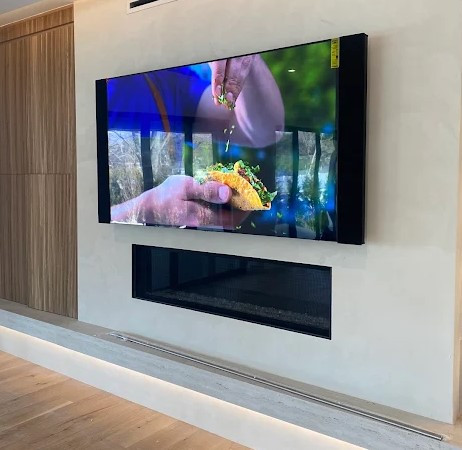
Should the TV Go Above the Fireplace?
From a viewing perspective, I'm generally not a huge fan of putting a TV above a fireplace. It often ends up higher than I would prefer.
But from a design perspective, I understand why it happens.
The fireplace may be the natural center of the room. The furniture faces it. Windows or other architectural details may limit the alternatives.
I love a well-designed built-in beside a fireplace where the TV can tuck into the room and become less prominent. That isn't always possible, and it isn't always the best answer for the house.
Sometimes a higher location also serves a secondary viewing area. A client may want to see the television from the kitchen behind the main seating area. That deserves consideration alongside the comfort of the people watching from the sofa.
There isn't one location that solves every room.
My job is to explain the tradeoffs and help the homeowner understand what the choice will feel like in everyday use. Any fireplace installation also needs to respect the fireplace and television manufacturers' requirements for heat exposure and clearance.
The Right Screen Size Belongs to the Room
I'm not a fan of putting the biggest possible TV into every space.
Some rooms have the scale and viewing distance to support a large screen beautifully. Others call for more restraint.
With the Wolverine Lake project, the existing television was too small for the viewing distance. Going larger solved a real problem. In a different room, increasing the size might make the television dominate a space where the client wanted a quieter presence.
If this is the main TV, I want it to be comfortable to watch and appropriate for the room.
Windows and reflections are part of that discussion, too. Many of the premium TVs we work with handle reflections well, but the actual light in the room still matters. We need to consider the screen, its position, and when the client expects to use it.
For an outdoor space, we also need to select equipment appropriate for the actual exposure and installation conditions.
The goal is a recommendation that fits how the space will be used.
A Designer Makes the Conversation Better
I love when an interior designer is involved.
A good designer understands the house as a whole: the lifestyle, the finishes, the feeling, and how one space relates to the next. They bring a perspective that makes the conversation more creative.
I'm comfortable finding ways to make a technical solution work. The designer helps establish the larger vision we're working toward.
Then we can coordinate with the builder and carpenters on the structure or cabinetry, and with the electrical team on power and other requirements.
That collaboration needs to happen before the details are finished.
For TV installations and media spaces in Birmingham, Northville, and throughout Southeast Michigan, early coordination gives us more room to work through screen placement, mounting, cable routes, sound, and access to equipment.
It also gives everyone an opportunity to identify a conflict while there are still good options for resolving it.
When the team understands the same vision and works together to deliver it, that's about as close as we get to luxury is confidence during the construction process.
Sound Should Follow the Purpose of the Space
The audio plan starts with the same question as the TV plan: what is this room supposed to do?
Is the goal comfortable everyday television sound? Music while people gather? A room where the family really wants to settle in and watch movies?
My selections change depending on those answers.
We have a lot of flexibility in how sound can fit into a room. Small-aperture speakers can coordinate visually with smaller lighting fixtures. Invisible speakers can help preserve the appearance of spaces where visible grilles would be difficult to arrange.
Those options still need to be selected and placed for the listening experience we want. A solution for background music may be different from the right arrangement for clear television dialogue or movie sound.
Wiring and connected equipment belong in that same conversation. We need to understand where things will live, how they will connect, and how someone will reach them when service is needed.
A clean installation should be thoughtfully planned behind the finished surfaces, too.
A Good Compromise Should Be Understood
There is almost always some give and take.
I want to protect the experience the client expects from the equipment. I also want to respect the design of the home.
Sometimes that means explaining why a location will be less comfortable for extended viewing. Sometimes it means accepting a technical compromise because the visual result matters more to the homeowner.
Experience helps us recognize which compromises are reasonable and which ones deserve a longer conversation.
At Wolverine Lake, the client understood that part of the window would be covered. He decided that the larger television and the experience it created were worth that tradeoff.
We weren't making that decision for him. We were helping him see the options clearly enough to make it confidently.
The Best Feedback Comes After People Live With It
A picture on the screen tells us the TV is working. The feedback after a client has used the room tells us much more.
I love hearing that someone enjoys watching movies there more than they expected. Or that they like having the TV on in the morning and being able to hear it while getting ready in the kitchen. Or that a concealed television has become one of their favorite things to show guests.
Those comments tell us the technology has found a place in their life.
Our Wolverine Lake client now has the outdoor viewing spot he wanted. It fits summer afternoons and fall football, and he's proud of the result.
That's the outcome we're working toward.
At Imagined Home Technology, we help homeowners in Birmingham, Bloomfield Hills, Northville, Plymouth, Grosse Pointe, and surrounding Southeast Michigan communities plan technology around their homes and the way they live.
If you're working through a TV location, a fireplace wall, or a custom built-in, bring us into the conversation while the options are still open.
Choosing the wall is the beginning. Creating a space you'll love using is the goal.