Can You Have Great Sound Without Seeing the Speakers?
By Lawrence Walters, Imagined Home Technology
When someone tells me they want great sound but don't want to see speakers, my first questions are about the room.
How will you use it? What finishes are going in? What do you want the space to feel like?
A kitchen where everyone gathers, a quiet sitting room, and a space built for entertaining may need very different approaches. Before we choose equipment, I want to understand the experience we're trying to create.
For me, one of the most important measures of good whole-home audio is comfort. You should be able to enjoy music throughout the space while still having a conversation. It should feel immersive without becoming overwhelming.
And yes, we can often create that experience with very little technology visible or with speakers that disappear into the finished room.
Visible, discreet, or completely concealed?
Traditional in-ceiling speakers still offer excellent value and performance. They can be a great choice when the grille fits comfortably into the design.
But ceilings have changed. We're seeing recessed lighting move from larger openings to four-inch fixtures and, in some cases, much smaller ones. A speaker grille that once looked perfectly proportionate may now feel oversized next to the lights.
When possible, I like to coordinate the size, shape, and placement of speaker grilles with the lighting. Small-aperture speakers give us another option: a compact visible opening, with more of the speaker assembly concealed above the ceiling.
Truly invisible speakers take a different approach. The speaker surface is installed flush and covered with the finish approved for that product. Once properly finished, there is no visible speaker grille.
Each approach has a place. In a custom home in Birmingham or Northville, the right choice might vary from room to room based on the architecture, listening expectations, and budget.
Sometimes the ceiling won't let everything line up
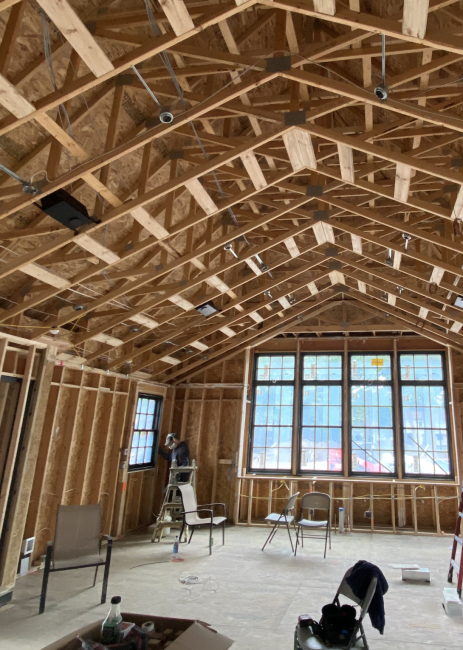
A clean ceiling layout can look straightforward on a drawing. Then you account for the framing, ductwork, plumbing, and the space the speaker needs behind the surface.
Small visible openings don't necessarily mean small housings. Sometimes the speaker simply cannot fit where its grille would look best next to the lights.
Invisible speakers can help solve that visual problem. They still need suitable mounting space and appropriate placement, but we aren't trying to align a visible grille with every other ceiling detail.
That gives us another way to protect the room's appearance while planning good sound coverage. It can be especially useful in spaces where the ceiling itself is an important part of the design.
Comfortable sound starts with coverage
Clients sometimes ask whether we can use fewer speakers or remove a subwoofer from the plan. It's a fair question, and I want them to understand why each part is there.
With whole-home sound, speaker placement and coverage matter as much as the appearance of any one speaker. If too few speakers are trying to cover a large room, people near them may find the music too loud while people farther away can barely hear it.
Thoughtfully distributed sound lets us aim for a more even experience. Depending on the speakers and the room, a properly integrated subwoofer may also help give the music the fullness the client expects.
I don't currently have a showroom, so explaining these decisions clearly is especially important. Clients are trusting my judgment. I need to understand whether they want gentle background music, something more energetic for entertaining, or a system they can sit down and really listen to.
Invisible speakers aren't automatically the right answer for every room. The recommendation should follow the way someone wants to listen.
Where Sonos and Control4 fit into whole-home audio
Choosing the speakers is only part of the system. We also need to decide how the music gets to them, what powers them, and how the family will use everything.
Sonos can bring streaming music to compatible built-in speaker systems. Depending on the design, a Sonos Amp can power suitable passive speakers, while a Sonos Port can provide streaming to a separate amplifier. Some architectural speakers require particular amplification or processing, so we select those components together.
Control4 gives us another way to organize audio as part of the broader home experience. Depending on the system and programming, clients can select rooms, adjust volume, and access music through a touchscreen, remote, app, or a programmed keypad button.
These are design choices, not requirements to add every possible control. Some households prefer a familiar music app. Others want a simple button they can press as they walk into the kitchen.
Recently, a client specifically wanted wall-mounted volume controls. That isn't a request we hear as often now, but it mattered to them. We planned around it.
Whether we're discussing Sonos installation, Control4 whole-home audio, or a simpler music system, the question stays the same: will this be comfortable for the people who live here to use?
A clean finish takes coordination before drywall
For the small-aperture and invisible speaker systems we install, coordination with the builder and finishing trades is critical. Depending on the product, housings, brackets, or speaker panels need to be installed at particular stages before drywall or final finishing.
We need to know about ceiling details that may be added later. Beams, trim, and other finishes can change what works. Rough-in placeholders help other trades see where equipment is planned, but they don't replace communication.
On a recent invisible-speaker installation, we were thinking carefully about how the edges would be supported and finished. The ceiling needs to look good after the installation is complete and continue looking good as the home is used.
That cleaner result takes coordination, clear instructions, and sometimes additional site visits. It's part of the work involved in making technology disappear.
Understand the installation and the long-term plan
The price of an architectural audio system includes more than the speakers. Wiring, amplification, installation, finishing, setup, and future access all deserve a place in the conversation.
I've found invisible speakers to be incredibly durable. Still, I want clients to understand what servicing their particular system would involve. Some speaker components can be accessed through an opening; a concealed installation may require opening and restoring the finished surface.
Warranty coverage varies by manufacturer and product. We should confirm what is covered, including any labor or finish restoration, rather than assume every part of a repair is included.
Knowing those details helps clients make a decision they feel good about.
Great sound should make the room more comfortable
When a client walks into the finished space, I want them to notice how comfortable it feels. The music is easy to start. It sounds good where people gather. Guests can talk and enjoy themselves without competing with the system.
That's another part of what we mean at IHT when we say luxury is confidence. You feel confident using your home, and confident that the people you've invited into it will be comfortable too.
Imagined Home Technology helps homeowners across Birmingham, Bloomfield Hills, Northville, Plymouth, Grosse Pointe, and surrounding Southeast Michigan communities plan whole-home audio around how they live. Whether the best fit is a traditional in-ceiling speaker, a discreet opening, or a fully invisible installation, we start with the room and the people who will enjoy it.
If you're building, renovating, or looking for a better music experience at home, we'd love to help you think through the possibilities.