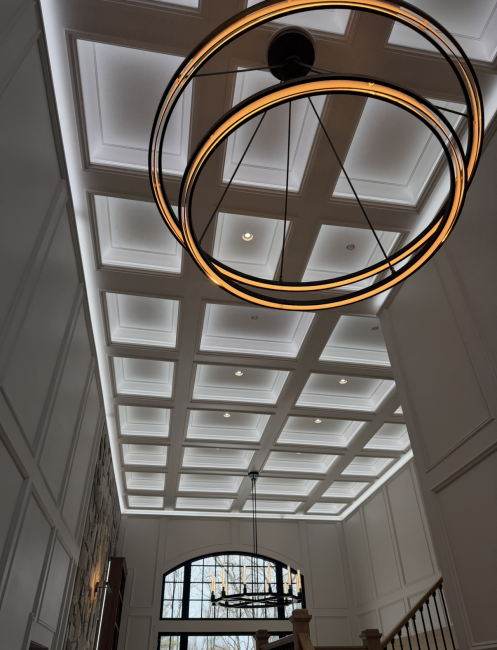
Beautiful Lighting Should Be Easy to Live With
By Lawrence Walters, Imagined Home Technology
I recently spoke with a client building a beautiful home. When we started discussing lighting control, the hesitation had nothing to do with the budget.
The system in their previous home had been executed so poorly that they wanted nothing to do with another one. Control4, Lutron it didn't really matter which name came up. They had already lived through the frustration and weren't interested in doing it again.
They wanted switches. They wanted to flip one and know the light would turn on.
I understand that.
I offered a small, focused solution as a possible starting point. Sometimes experiencing something simple and dependable helps someone become comfortable with the idea. In this case, they weren't interested.
At that point, my job was to help them make the best of the approach they chose. I can explain the options and tradeoffs, but it's not my house at the end of the day.
That conversation stayed with me because it gets to the heart of what good lighting control should deliver: confidence.
A beautiful lighting plan needs a plan for using it
Custom homes can have a surprising number of lighting circuits in a single room.
Think about a kitchen. There may be recessed lights for general illumination, pendants over the island, lighting under the cabinets, linear lighting inside a feature, and decorative fixtures nearby. Each layer serves a purpose. Some help you work. Others create atmosphere or bring out the beauty of stone and millwork.
Those layers can make a room feel incredible. But if enjoying them means adjusting eight separate switches or dimmers every evening, we have more design work to do.
A wall full of switches doesn't necessarily mean the lighting itself was poorly planned. It can mean the way someone would use that lighting didn't get the same attention.
When we're discussing smart lighting for a custom home in Birmingham or Bloomfield Hills, I want to understand both: how the room should look and what it should take to make it feel that way.
More lighting options mean more decisions to coordinate
Lighting today can do a lot. Depending on the fixture, we can change color, adjust the warmth of white light, or have the light become warmer as it dims.
The challenge is getting the different fixtures and lighting layers to work together in a way that feels natural.
This is where thoughtfully designed lighting control can make a real difference. Systems from Lutron and Control4, and compatible integrations with platforms such as Josh AI, give us options for coordinating the experience. The right approach depends on the fixtures, the home's infrastructure, and what the client actually wants to do.
We need to consider compatibility and performance during design. A control system still needs suitable fixtures, the right components, and careful setup behind it.
The homeowner should be able to choose a comfortable evening setting without thinking through all of those details every time.
Plan lighting controls before the walls close
The best time to discuss switches, keypads, and lighting panels is as early as possible. By the rough electrical walkthrough, those decisions should be getting specific.
The homeowner, interior designer, electrician, and technology integrator all bring something important to that conversation. Where will someone enter the room? Where will the furniture go? Which walls feature millwork, stone, or artwork? Where would a control be most useful?
Panelized lighting also needs planned space for the equipment and coordination of the wiring. That space can be surprisingly difficult to find once the rest of the house has been accounted for.
When we're brought in late, we're often finding somewhere to put a keypad instead of choosing the best place for it. There may still be good solutions, but the options get narrower.
Whether you're building in Northville, Plymouth, Grosse Pointe, or elsewhere in Southeast Michigan, lighting control belongs in the design conversation while there is still time to act on it.
Fewer controls, with clear purposes
With a panelized lighting design, switching and dimming equipment is located in panels, allowing a keypad in the room to control multiple lighting circuits. That can significantly reduce the number of controls on the wall.
One keypad at a given location may cover the room's main needs. Larger spaces or rooms with multiple entrances may need additional control locations. The goal is to make the controls useful, easy to reach, and appropriate for the design.
I like to keep the choices simple. Bright, Evening, and Night might be enough for one room. In another, Cooking, Entertain, and Clean Up may better describe how the family uses it.
You don't need a scene for every possible scenario. A few clear, engraved buttons are easier to understand than a long list of overlapping choices.
We can also refine those settings once clients have lived in the home. Sometimes they discover that their evening setting needs to be a little softer, or that they use a room differently than they expected.
Let routine lighting follow the routine
Some lighting shouldn't require much thought at all.
Exterior lighting is a good candidate for a schedule. Closets, storage areas, and certain hallways may benefit from occupancy or motion sensing. Traditional switches can also be perfectly appropriate in utility spaces.
These decisions should reflect how the household lives. A sensor that is helpful in one space may be irritating in another. Scheduled lighting should still allow practical manual control when someone's plans change.
Consistency matters, too. Once someone understands the controls in one part of the house, moving into another room should feel familiar.
Confidence is part of the design
I still think about that client who wanted ordinary switches after a bad experience.
Their priority was completely reasonable: they wanted to know what would happen when they reached for the wall. Any lighting system we recommend should earn that same trust.
If they choose conventional controls, we should still help make the layout thoughtful and the experience as comfortable as possible. Being an advisor includes respecting an informed decision.
To me, beautiful lighting means the right lights, at the right intensity and color temperature, for the moment you're in. The controls should make that feel effortless.
That is what I mean when I say luxury is confidence. You press a button and know what will happen. You feel comfortable in your home. The people who helped design it understood how you wanted to live.
If you're planning a custom home or renovation in Southeast Michigan, Imagined Home Technology can help coordinate lighting control with your builder, electrician, and interior designer. It's a conversation worth having while your best options are still available.
https://www.imaginedht.com/blog/2026-07-01/smart-lighting-worth-it-custom-home