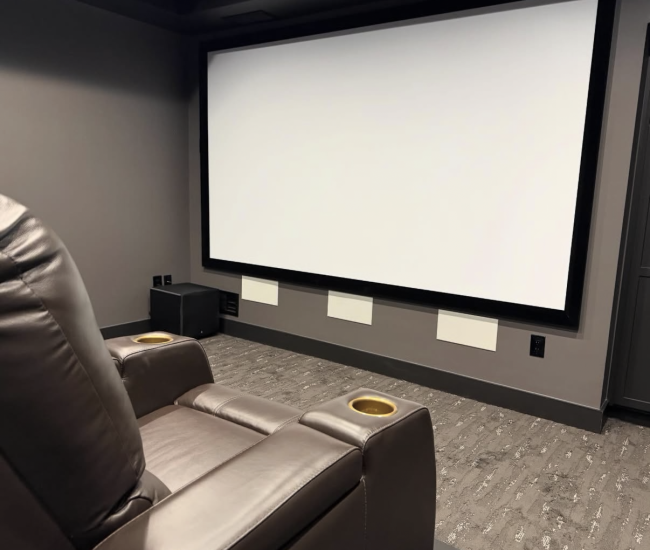
What Makes a Home Theater Truly Great? (Hint: It's Not Just a Bigger Screen.)
When people first ask me about building a home theater, one of the first questions I ask isn't about projectors, speakers, or screen size.
It's simple.
Why do you want one?
The answer to that question shapes every decision that follows.
Some people have dreamed of having a dedicated movie room since they were kids. Others want a place where the whole family can gather for Friday night movies without fighting for seats in the living room. Some are avid gamers looking for an immersive escape after a long day. One of my clients works in emergency medicine at a local hospital. After spending long shifts making high-pressure decisions, his home theater became the place where he could disconnect, play video games, and recharge.
Those are very different goals.
And they deserve very different rooms.
A Great Home Theater Starts With Purpose
One of the biggest misconceptions about a home theater is that it's simply a room filled with expensive equipment.
In reality, the equipment should support the experience not define it.
Before we talk about a projection system, surround sound, or seating layouts, I want to understand how the room will actually be used.
Will it be a place for family movie nights?
Will friends gather there to watch football every weekend?
Is it a quiet retreat for someone who wants to escape into a great film after work?
Will it become the favorite gaming room in the house?
When we understand the purpose of the room, the technology becomes much easier to design.
The Best Home Theaters Aren't Always the Most Expensive
One thing I've learned after nearly twenty years designing home theaters is that bigger budgets don't automatically create better experiences.
Some of my favorite theaters have been relatively modest projects.
What made them exceptional wasn't how much was spent.
It was how well they were planned.
When we're involved before the walls go up, we have the flexibility to make thoughtful decisions about screen size, seating locations, speaker placement, equipment storage, lighting, and room proportions. Instead of forcing equipment into an existing space, we can design the room around the experience the homeowner wants to create.
That flexibility almost always produces a better result than simply buying more expensive equipment later.
Comfort Matters Before the Movie Even Starts
One of the first things people notice when they walk into a well-designed theater has nothing to do with the picture.
It's the way the room feels.
The seating feels intentional.
The viewing distance feels comfortable.
Everyone has a great sightline to the screen.
The second row sits at the proper height.
Nothing feels cramped or awkward.
If the seating isn't right, you can usually sense something feels off before the movie even begins.
Great home theater design should disappear into the background, allowing everyone to relax without thinking about why the room feels so comfortable.
A Quiet Room Creates a Better Experience
Another characteristic of a great theater is something many people don't immediately notice.
It's quiet.
Proper acoustic treatment does much more than improve sound quality. It helps separate the room from the rest of the house. Outside noise fades away. Echoes disappear. The room begins to feel like its own environment.
That's important because the goal isn't simply louder audio.
The goal is immersion.
When distractions disappear, it's much easier to become completely absorbed in a movie, a game, or a live sporting event.
For a little while, the outside world simply fades away.
The Best Technology Is the Technology You Stop Thinking About
One of my favorite ways to judge a theater has nothing to do with technical specifications.
I ask myself a simple question.
Do I ever feel like reaching for my phone?
In a truly great theater, the answer is usually no.
The room captures your attention. The lighting feels right. The sound draws you in. The seating keeps you comfortable. The technology quietly gets out of the way and lets the experience take over.
That's exactly what great smart home technology should do.
People Hire Us to Buy Back Time
One philosophy guides nearly every project we design at Imagined Home Technology.
People hire us to buy back time.
Not simply to install equipment.
Not because they couldn't hang a television themselves.
They hire us because they want a space that's actually worth spending two or three hours in on a weekend.
If turning on the room feels complicated, we've failed.
If someone spends twenty minutes searching for remotes, troubleshooting inputs, trying to remember which button controls the projector, or figuring out why the movie won't start, the room has already created friction before the opening scene ever begins.
We believe technology should remove stress not create it.
That's why we spend so much time designing systems that feel intuitive, reliable, and effortless. When you finally have an evening free, your theater should simply work.
Every time.
The Best Home Theaters Become Part of Family Life
At the end of the day, people don't build home theaters because they need another screen.
They build them because they're creating memories.
It's family movie night without crowded theaters.
It's inviting friends over for the big game.
It's introducing your kids to the movies you loved growing up.
It's escaping into a favorite video game after a demanding week.
It's having one place in the home where the outside world can wait until tomorrow.
That's what makes a home theater truly great.
It's not the projector.
It's not the speakers.
It's not the budget.
It's creating a space people genuinely look forward to using.
Because when the room disappears and all that's left is the experience, you've built something far more valuable than a home theater.
You've built one of the favorite rooms in the house.