Why Should You Plan Wi-Fi Before Drywall in a Custom Home?
If you are building a custom home in Birmingham, Bloomfield Hills, Northville, Plymouth, Grosse Pointe, or anywhere throughout Southeast Michigan, Wi-Fi planning should happen long before move-in day.
A lot of people think Wi-Fi is something you can figure out later. In a smaller home or apartment, that may be true. In a large custom home with detailed ceilings, millwork, outdoor spaces, thick walls, and a family depending on the network every day, that approach usually creates problems.
At Imagined Home Technology, we look at the network as the backbone of everything we do.
It supports the music, streaming, smart home control, lighting, cameras, doorbells, Wi-Fi calling, home offices, kids doing homework, gaming, and almost every connected device in the home.
When the network is stable, the home feels easy.
When the network is weak or unstable, everything connected to it starts to feel harder than it should.
Wi-Fi Planning Is Both a Performance Decision and a Design Decision
One of the most challenging devices to place in a new home is the Wi-Fi access point.
Access points perform best when they are visible, open, and have a clean path to the devices using them. The challenge is that the best performance location is not always the prettiest location.
In a custom home, the spaces where people care most about Wi-Fi are often the spaces with the most design detail.
Kitchens, offices, outdoor areas, primary suites, living rooms, and lower levels may include beams, paneling, tray ceilings, ceiling details, custom millwork, or other architectural features. These details can make the home beautiful, but they can also affect where access points should go and how well they perform.
When an access point is hidden, it may look better, but it can reduce coverage and speed. When it is placed out in the open without considering the design, it may work better but become an eyesore.
That is why we want to be brought in early.
The goal is not just strong Wi-Fi. The goal is strong Wi-Fi that does not fight the architecture of the home.
What Happens When Wi-Fi Is Treated as an Afterthought?
When Wi-Fi is planned too late, the access point often lands wherever the wire was easiest to run, not where it makes the most sense for the home.
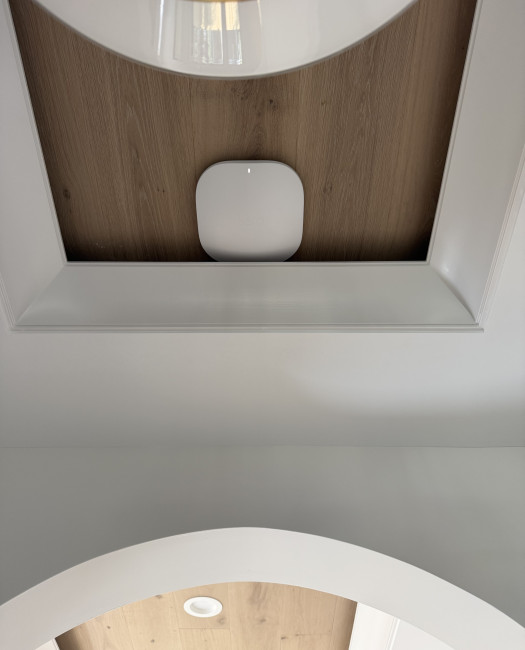
I am working on a project now that someone else wired, and the access point is located in the middle of a paneled ceiling detail. Technically, it may work. But visually, it is in one of the worst possible places. It will be an eyesore in a space that was clearly meant to feel intentional.
That is the kind of thing that can usually be avoided with early planning.
When we are involved early, we can talk with the homeowner, designer, builder, and electrician about the details of the home before everything is finalized. We can understand the ceiling details, millwork, layout, insulation, outdoor spaces, and the areas where the family will actually use the network.
If Wi-Fi is planned late, you may end up choosing between performance and aesthetics.
If it is planned early, you have a much better chance of getting both.
The Home Itself Can Create Wi-Fi Problems
In larger custom homes, Wi-Fi issues are often created by the structure and design of the home.
Millwork, insulation, beams, paneling, thick walls, mechanical areas, lower levels, large open spaces, and ceiling details can all affect signal strength.
The more we understand about the construction and architectural details, the better we can plan for smooth, even coverage.
A good Wi-Fi plan is not about simply adding more access points everywhere. There is a balance between having enough coverage and oversaturating the home. Too many access points in the wrong locations can create problems of their own.
The goal is even, reliable coverage where people actually live, work, and gather.
That includes the obvious spaces like offices, kitchens, bedrooms, and family rooms. But it also includes places that can be missed during the planning process, like lower levels, garages, patios, pools, detached garages, guest houses, pool houses, and outdoor entertaining areas.
Outdoor Wi-Fi does not happen by accident.
If there is a lot of hardscape, a pool area, a long driveway, or a detached structure, those spaces may need their own infrastructure. Sometimes that means conduit. Sometimes it means fiber. Sometimes it means planning around distance and blind spots before concrete, landscaping, and hardscape make changes much harder.
Mesh Wi-Fi Has Its Place, But It Is Not the Same as a Planned Network
Mesh Wi-Fi systems have become very popular, and they solve a real problem.
They are common in starter homes, apartments, condos, and older homes that may not have wired infrastructure. They also helped homeowners understand that one router in one corner of the home is usually not enough.
That part is a positive.
The downside is that mesh systems often require devices to sit out on counters, shelves, desks, or furniture. They need power. They can have visible cords. Their placement is often based on where an outlet is available, not where the Wi-Fi should actually perform best.
Depending on how the mesh system is connected, you can also sacrifice speed and reliability.
In a custom home, we usually have a better option: wired access points that are planned before drywall.
With wired access points, the home can be designed for cleaner aesthetics, stronger performance, and more predictable coverage. The access points can be placed intentionally instead of being added later wherever they happen to fit.
Mesh is often a good solution when the home was not designed for Wi-Fi.
Wired access points are usually the better solution when the home can be designed for Wi-Fi from the beginning.
The Internet Provider’s Gateway Is Rarely Enough
Another common misconception is that the gateway from Xfinity, AT&T, or another internet provider will cover the whole house.
In a smaller home or apartment, that may be fine.
In a large custom home with multiple floors, custom finishes, outdoor spaces, thick walls, and a lot of connected devices, it is rarely enough.
The internet provider’s gateway may bring internet into the home, but it should not be expected to distribute Wi-Fi evenly throughout a large custom home.
A custom home deserves a network that is designed into the home, not added to the home after the fact.
The Network Is the Backbone of the Smart Home
The network is not just about fast internet.
It supports the entire client experience.
Streaming music through Sonos, Spotify, Apple Music, or Pandora needs a stable connection. Streaming TV through Netflix, Max, Disney+, YouTube, and other services needs reliable bandwidth. Control systems like Control4, lighting systems like Lutron, voice control like Josh AI, camera systems, Ring doorbells, thermostats, garage systems, pool systems, and personal devices all rely on the network.
Wi-Fi calling should work.
Home offices should feel dependable.
Kids should be able to do homework, stream, game, and use their devices without constant frustration.
The client should not have to think about the network. They should just be able to live in the home.
When the network is weak or unstable, music cuts out, streaming buffers, cameras disconnect, voice control feels slow, and the smart home experience becomes inconsistent.
That is why we treat network design as infrastructure, not an afterthought.
A Great Network Also Needs Stability and Support
For IHT, a great network is not only about coverage. It is about stability, recovery, and support.
We use better network equipment, battery backup, remote monitoring, and service support to help create a more stable client experience.
Platforms like OvrC and WattBox allow us to strategically reboot critical devices when needed. Battery systems help important equipment stay powered, run longer, crash less, and recover more cleanly from power interruptions.
We also offer service plans with third-party 24/7 support so clients can have help when they need it.
The best smart home systems are not just designed to work. They are designed to recover.
That does not mean a system will be perfect. Technology still needs support. But the right plan makes the home more stable and makes recovery easier when something goes wrong.
“Can’t We Just Figure Out the Wi-Fi After We Move In?”
You can, but that is not the way I would approach a custom home.
I think about Wi-Fi planning the same way I think about HVAC planning.
You would not want to move into a new home and find out the upstairs is always too hot in the summer or too cold in the winter because the HVAC was not planned well. You also would not want the system to have to work harder than it should just to make the home comfortable.
Wi-Fi is similar.
It needs to be thought of from the ground up.
If the network does not cover the areas your family really cares about, or if you have to rely on ugly devices plugged into outlets as an afterthought, it does not really feel custom.
Homeowners spend so much time thinking about finishes, lighting, flooring, cabinetry, countertops, and furniture. The last thing you want is for something as important as Wi-Fi to feel unplanned.
When Should You Bring IHT Into the Conversation?
The best time to involve us is early in the design and planning process, before drywall and ideally before major ceiling details, millwork, and outdoor infrastructure are finalized.
We want to understand how the family will live in the home.
Where will people gather?
Where will they work?
Where will they stream, entertain, and relax?
What areas of the home are most important day to day?
What outdoor spaces need to feel connected?
Where can equipment live without hurting the design?
When we are part of the conversation early, we can coordinate with the builder, designer, electrician, and other trades to make sure the network supports both the performance and the look of the home.
For custom homes in Birmingham, Bloomfield Hills, Northville, Plymouth, Grosse Pointe, and throughout Southeast Michigan, Wi-Fi planning should not be left until move-in.
It should be part of the home from the beginning.