Should You Prewire a Custom Home for Smart Technology in Southeast Michigan?
If you are building a new custom home in Birmingham, Bloomfield Hills, Northville, Plymouth, Grosse Pointe, or anywhere throughout Southeast Michigan, one of the questions that should come up early is:
Should we prewire the home for smart technology?
My answer is almost always yes.
But the real answer is a little more thoughtful than that. The extent and scope of the prewire should depend on the client, the type of home being built, the budget, and how the family wants to live in the space.
A good prewire is not about stuffing wire into every possible location. It is about understanding the way the home will function, where the family will spend time, how they entertain, what matters now, and what should be protected for the future.
At Imagined Home Technology, we look at this as client first, technology second.
Not Every Custom Home Needs the Same Prewire
Some homes need a more complete technology plan than others.
The first type is what I would call a lifestyle-forward home. These are clients who want music, video, and strong Wi-Fi throughout most of the home. They may love to entertain, host family gatherings, spend time outside, watch movies together, or create spaces where their kids and family can hang out comfortably.
For these clients, technology is not just about gadgets. It is about experience.
An entertaining-focused client may want music in the kitchen, patio, pool area, lower level, bar, or main living spaces. But the system should not only be able to get loud. It should also sound smooth at lower volumes so people can have dinner, talk comfortably, and enjoy the space without feeling overwhelmed. Then, when the night becomes more fun and high-energy, the system should be able to support that too.
A family-forward client may care more about strong Wi-Fi for homework, a space for kids to hang out, or an immersive family movie night. These spaces often involve collaboration with an interior designer, and when they are planned well, they can become some of the coolest parts of the home.
The second type is an investment-conscious luxury home. This client may not plan to live in the house forever, but they still want the home to have the right basic luxury infrastructure. They may not finish every feature on day one, but they understand that having a robust wiring plan inside the walls can make a huge difference later.
In both cases, the goal is the same: make smart decisions before the walls close.
Why Prewire Before Drywall?
It is always easier and usually less expensive to run wire before drywall.
Once drywall goes up, some pathways close. Some areas become difficult or nearly impossible to access cleanly. What may have cost hundreds of dollars during construction can turn into thousands of dollars later when you have to cut, patch, paint, or compromise on the finished look of the home.
My general rule is this:
If it is 50/50, run the wire. Spend hundreds now rather than thousands later.
That does not mean every possible wire needs to be run everywhere. But if there is a reasonable chance that a space may need Wi-Fi, music, a TV, a camera, or some other technology later, it is usually smarter to plan for it while the home is open.
The Biggest Area to Plan For: Wi-Fi
The biggest one is Wi-Fi.
Almost everything in a modern home depends on the network. Phones, laptops, TVs, streaming, Sonos, cameras, thermostats, lighting, control systems, doorbells, and even appliances all rely on a strong network foundation.
The more places we can properly place wired access points, the better.
It is not always easy to know exactly where the trouble areas will be until the home is finished and the family is living in it. Construction materials, floor plans, mechanical systems, outdoor areas, and the way the family actually uses the home can all affect performance.
Yes, there are mesh systems and wireless access points. Those can work in some situations. But in a custom home, they often create visible cords, devices sitting out, or equipment placed in areas where it does not look good.
Prewiring for Wi-Fi gives the home better options. It allows access points to be placed where they perform well and look intentional.
Music, TVs, Lighting, and Shades
Music is another area where planning matters.
Wireless speakers can be useful, but they often create clutter. In a home where design matters, visible cords and devices sitting out can take away from the look and feel of the space. If music is important in kitchens, patios, pools, lower levels, or entertaining spaces, it should be part of the early plan.
TV locations should also be considered early. Even if every TV is not installed right away, the home should be prepared for clean TV placement without exposed wires, awkward outlet locations, or limited options later.
Lighting control is another major category. If you do not want six light switches on a wall, that needs to be planned before the home is finished. A lighting control system can allow you to use clean keypads while switches or dimming equipment are located in closets, pantries, mechanical spaces, or lighting panels.
That is not just a technology decision. It is a design decision.
Shades are more nuanced. If shade pockets are being engineered and automated shades are important to the client, the wiring should be planned early. But if shades are not mission critical, or the window treatments have not been selected yet, hardwiring is not always the right answer. Shade wire can be difficult to hide if the treatment is not planned properly, and wireless shade options are often not that big of a compromise.
The right answer depends on the home, the design, and the client’s priorities.
The Most Common Mistake: Bringing Us In Too Late
One of the most common mistakes we see is that the technology team is not brought in early enough.
Decisions are already being made on millwork, finishes, ceiling details, lighting, and overall layout with little or no consideration for music, Wi-Fi, lighting control, TVs, shades, or equipment locations.
We have a huge toolbox of solutions, but when we are brought in late, we are often using those solutions to solve problems instead of selecting the right solution based on the original vision.
When we are involved early, we can design around the vision.
When we are involved late, we are often working around decisions that have already been made.
That does not mean a late project cannot turn out well. It just means there are usually more compromises.
Lighting may feel added on instead of sleek and functional. Speaker placement may lose symmetry because of framing, beams, or carpentry. Shade pockets may not exist or may be poorly engineered. The equipment rack location may not be defined, which means we are now trying to squeeze it into a closet, mechanical room, or cabinet that was never designed for it.
Late planning does not always ruin a project, but it does reduce the number of elegant options.
Prewire Does Not Mean Buying Everything on Day One
A good prewire plan gives the client flexibility.
It does not mean every speaker, TV, keypad, or finished feature has to be purchased right away.
For network and speaker locations, we can often run wire during construction and leave it safely hidden in the ceiling or wall for future use. We have tools that allow us to trace and locate those wires later. There are also placeholder options for speakers that allow a room to look finished without requiring the client to buy every speaker immediately.
The way I think about it is simple:
Prewire prepares the home. The finished system activates the experience.
That distinction matters because it helps control budget without closing the door on future options.
How We Think About Budget and Scope Creep
Scope creep is always a concern on a project. I have never experienced a client who truly had no budget and did not want to be smart with how they invest.
That is why the conversation has to be open and transparent.
The goal is not to push everything a technology professional thinks is exciting. The goal is to understand the client’s real wants, needs, and priorities.
I want to know the hot areas of the home.
Where are you going to spend the most time?
Where do you love to entertain?
Where have you put the most design energy and care?
Which spaces should feel truly special?
Which spaces just need to be clean, reliable, and ready for the future?
Those questions help us decide what should be finished now, what can wait, and what should be protected for later.
A smart prewire is not about saying yes to everything. It is about knowing what matters most.
A Real-World Lesson From a Large Custom Home
We are currently in the later stages of one of the largest wiring projects we have done to date.
The home is basically finished, and the client is starting to live in it. They have a young, active family and love to entertain and host large family gatherings. We were involved very early and have been working with them for over two years.
The home includes a full Lutron lighting system, Sonos, Josh AI, and Control4 to help fill in the gaps and tie parts of the experience together.
The client has been great, the relationship has been great, and the project was planned in a very thoughtful way.
Even with all of that planning, the home still revealed a few gaps once the family started actually living in it. There were transition spaces where music could have added more to the experience. There were also a few Wi-Fi areas that needed to be boosted.
The important part is that we could address those things because the infrastructure was strong enough to expand.
That project is a good reminder that you cannot perfectly predict every way a family will use a home until they are living in it. The goal of a good prewire is not perfection. The goal is flexibility.
A smart prewire does not eliminate every future adjustment. It gives you better options when real life reveals what the home actually needs.
When Should You Contact IHT?
The best time to contact us is when planning begins and the build team is coming together.
Ideally, we are part of early planning and design meetings with the builder, designer, architect, electrician, and other trades. That allows us to build trust with the team, communicate clearly, protect the client’s vision, and help avoid costly mistakes.
If you are very early in the process, the plan can develop more organically around your lifestyle, design goals, and budget.
If the project is further down the line, framing has started, or trades are already working, we can still help. The conversation just becomes more realistic around what is already there, what can still be changed, and what compromises may be needed.
It is never too late to call us, but the best results happen when we are part of the team from day one.
Early technology planning is not just about wiring. It is about protecting the vision of the home and making sure the technology feels intentional, simple, and easy to live with.
If you are building a custom home in Birmingham, Bloomfield Hills, Northville, Plymouth, Grosse Pointe, or anywhere throughout Southeast Michigan, prewire planning is one of the most important conversations to have before the walls close.
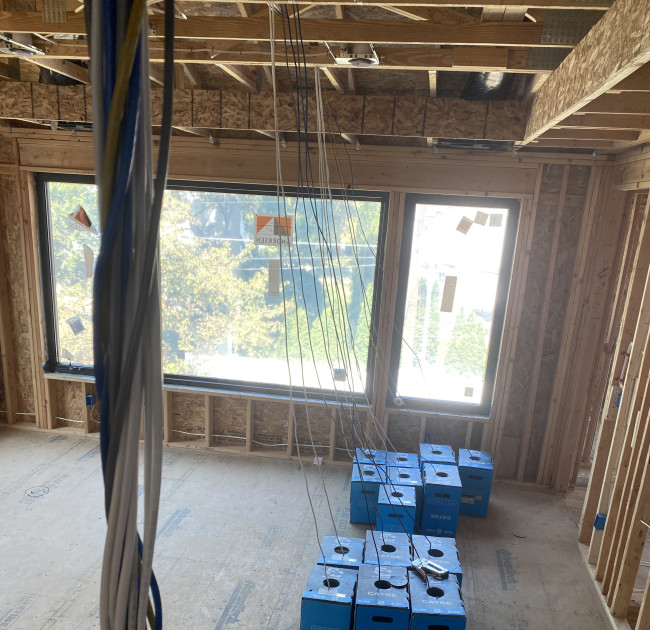
We pull different color wires for different devices this makes it easier to identify what a specific cable was intended for.